Course Introduction and Learning Journey
Start with the decision, not the spreadsheet
Published by IGBS-SBDG, AI-Powered Scenario Analysis is an advanced Level 3 professional course for financial analysts, FP&A professionals, corporate finance teams and finance decision-makers in Egypt and the Middle East. It focuses on turning uncertain business conditions into structured, explainable decisions using financial modelling, scenario techniques and AI-assisted analysis.
The guided core path takes approximately 2 hours 30 minutes (150 minutes). Optional deep dives and the capstone assignment require additional time. The course assumes that you already understand financial accounting, have basic AI literacy and can work confidently in Excel.
By the end of the course, you will be able to:
- explain how scenario analysis differs from forecasting and sensitivity analysis;
- structure drivers, assumptions, cases and probabilities;
- prepare financial data for AI-assisted analysis;
- use ChatGPT and Claude as controlled analytical co-pilots;
- build and compare revenue, cost, cash-flow and three-statement scenarios;
- assess uncertainty with risk indicators and Monte Carlo simulation; and
- apply governance, privacy, validation and communication controls to AI-supported finance work.
You will practise these capabilities through one fictional running case rather than disconnected examples.
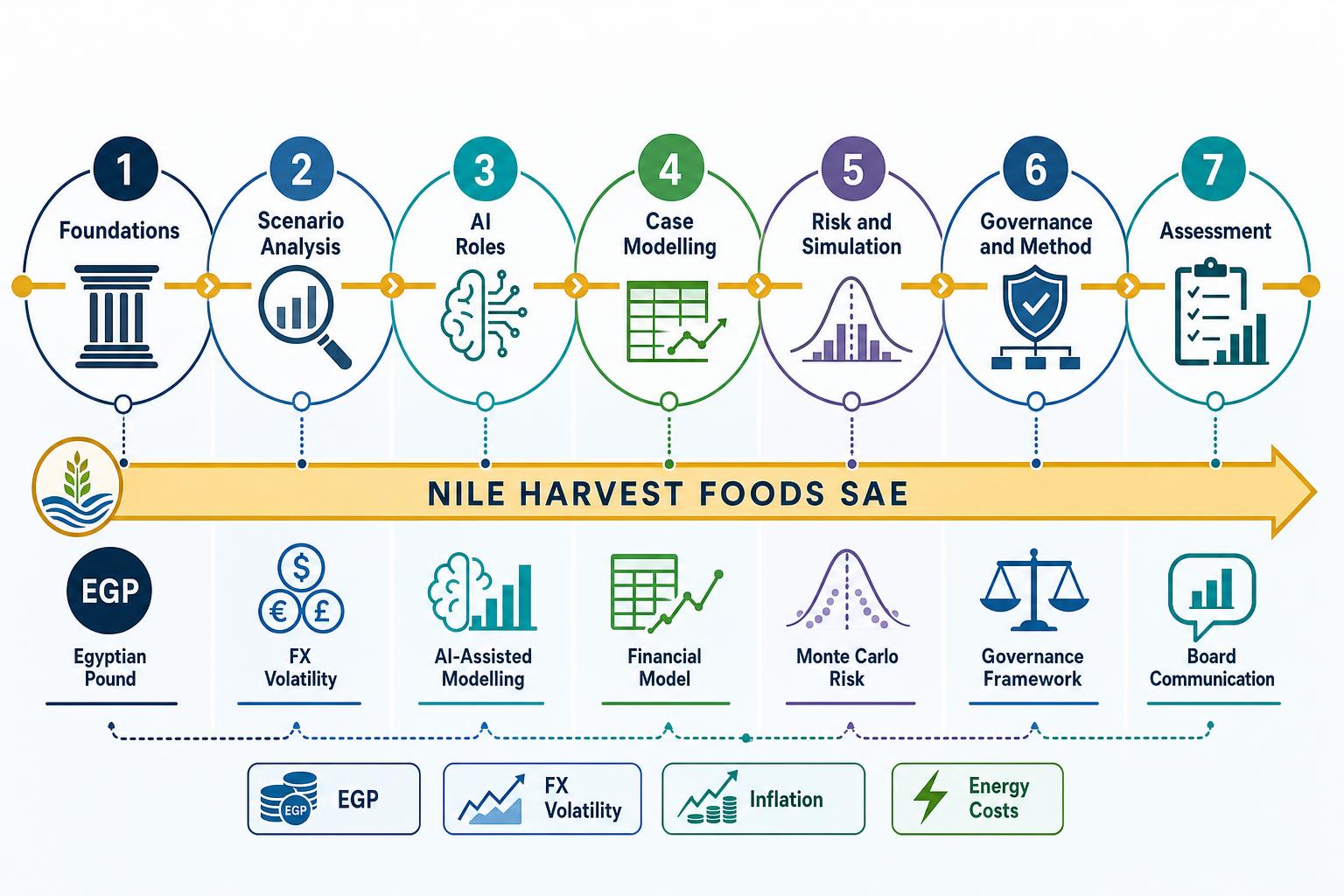
| Module | What you will do | Running-case connection |
|---|---|---|
| 1. Getting Started | Set up the workflow, tools and secure working habits. | Understand the company and decision context. |
| 2. Introduction to Scenario Analysis | Distinguish scenarios from forecasts and sensitivities; structure drivers, cases and probabilities. | Frame EGP, inflation, energy and demand shocks. |
| 3. Role of AI in Scenario Analysis | Select appropriate AI, generative AI and BI capabilities, with review gates. | Decide where AI can assist and where finance judgement remains essential. |
| 4. Leveraging Generative AI | Prepare data, build forecasts, model scenarios, visualise results and link statements. | Develop the full analysis for the company. |
| 5. Risk Assessment | Connect scenarios to risk and use Monte Carlo simulation. | Interpret uncertainty around costs, demand, FX and cash. |
| 6. Course Summary | Apply the end-to-end method, governance, privacy and staying-current controls. | Turn analysis into a defensible management recommendation. |
| 7. Final Assessment | Complete the advanced final exam and board-ready capstone assignment. | Demonstrate an integrated scenario-analysis workflow. |
Open each section to connect the course structure with the work you will perform.
🏭 The running case: Nile Harvest Foods SAE
Nile Harvest Foods SAE is a fictional mid-sized Egyptian FMCG manufacturer. Across the course, you will analyse its EGP-denominated financial position under changing exchange rates, inflation, energy costs and demand. The case provides a consistent context for assumptions, calculations, visualisations, risk analysis and management recommendations.
📈 How the case develops
You begin by defining the decision and organising the evidence. You then build a baseline, introduce coherent shocks, compare outcomes and investigate uncertainty. Later work links operating assumptions to profit, cash flow and the wider three-statement model.
✅ Assessment overview
Knowledge checks appear throughout the lessons. The course concludes with a 30-question advanced final exam covering foundations, case modelling, risk, Monte Carlo simulation and governance, followed by a board-ready scenario-analysis capstone with a weighted grading rubric.
🎙 Narrated lesson script
Welcome to AI-Powered Scenario Analysis, published by IGBS-SBDG. This advanced course is designed for finance professionals working in Egypt and the Middle East. You will use a fictional Egyptian FMCG manufacturer, Nile Harvest Foods SAE, to connect financial modelling with AI-assisted analysis. Starting with scenario foundations, you will progress through data preparation, forecasting, visualisation, linked statements, risk simulation and governance. The guided core takes about 150 minutes. To benefit fully, bring your knowledge of financial accounting, basic AI concepts and Excel. Treat AI as a controlled analytical co-pilot: it can accelerate exploration and communication, but your financial judgement, validation and accountability remain central.
Use these four points as your mental checklist before beginning the next lesson.
🎯 Purpose
Convert uncertainty into structured, decision-ready financial analysis.
💼 Audience
Advanced finance professionals and decision-makers in Egypt and the Middle East.
🔗 Method
One running FMCG case links every stage, from assumptions to recommendation.
🛡 Discipline
AI accelerates analysis; people validate data, logic, privacy and decisions.
There are no comments for now.
to be the first to leave a comment.