Welcome to AI-Enhanced Financial Analysis
What you will be able to do
By the end of this guided core lesson, you will be able to:
- explain how AI augments—not replaces—professional financial analysis and judgement;
- identify where AI can assist across the analytical workflow, from data ingestion to challenge and communication; and
- describe how the course uses a fictional Egyptian FMCG company to connect methods, evidence and decisions.
AI-Enhanced Financial Analysis, published by IGBS-SBDG, is designed for FP&A professionals, finance and accounting leaders, and financial analysts working in Egypt and the Middle East. It assumes that you already understand accounting, financial statements, financial analysis, critical thinking, mathematics and statistics. The purpose is not to make financial judgement optional. It is to help you apply that judgement more consistently, efficiently and visibly.
Generative AI can read structured instructions, transform data, draft explanations, generate Excel formulas or Python code, identify possible patterns and challenge an initial interpretation. It can also produce a confident but unsupported answer, misread a unit, apply the wrong denominator or invent a plausible explanation. In professional finance, speed without control increases risk. The central discipline of this course is therefore controlled augmentation: use AI to extend human capability while retaining human accountability for definitions, calculations, interpretation, recommendations and approval.
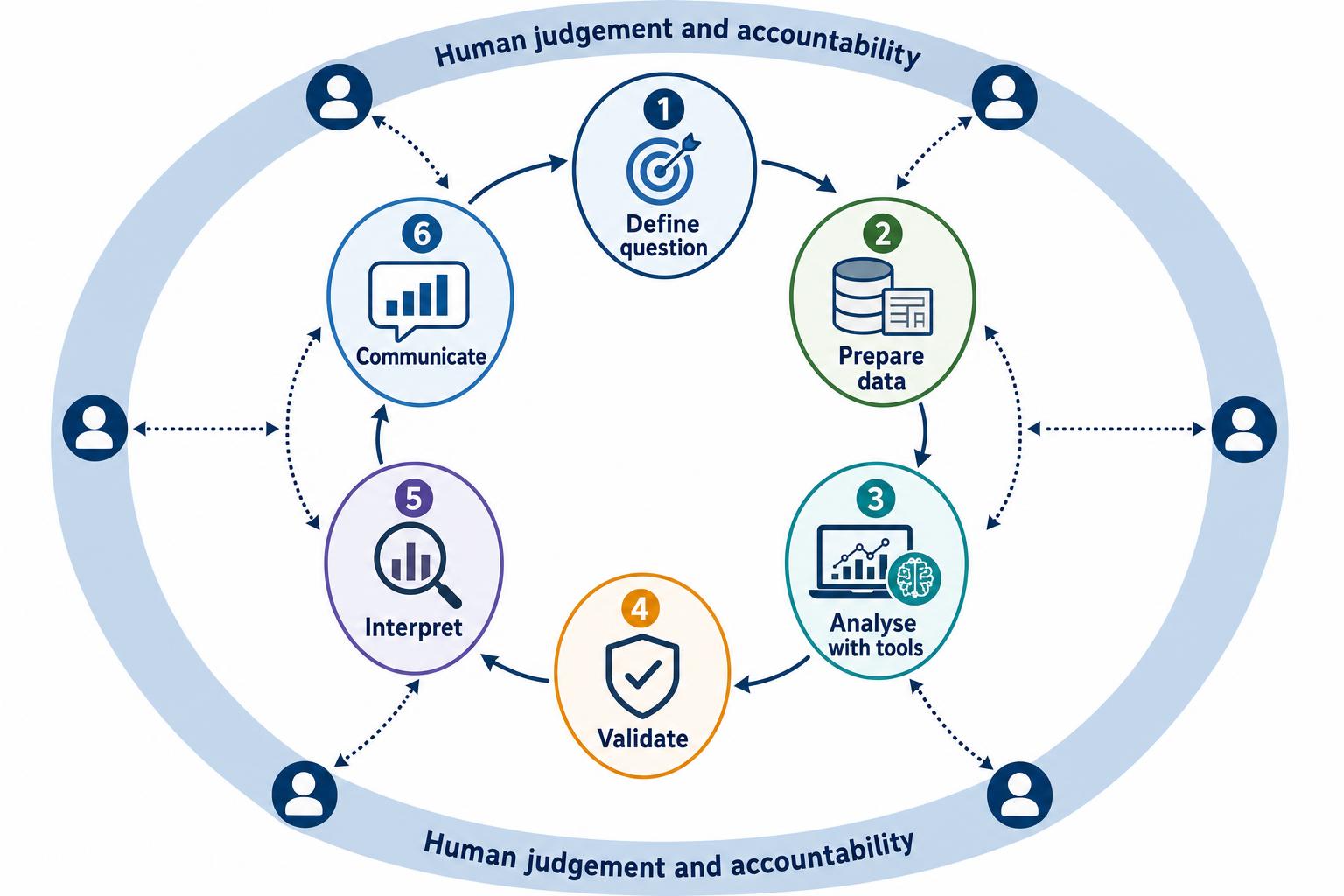
The course workflow
The workflow below is deliberately broader than “ask an AI tool for an answer”. It links a business question to evidence, methods, review and a decision. The same logic will be applied to ratios, statement analysis, forecasting, FP&A and risk.
Trace the six stages in order, noting the human responsibility that remains at each stage.
Define the question. Start with the decision the analysis must support: for example, whether a change in gross margin requires an operational response. Specify the period, comparison basis, materiality, audience and desired output before selecting an AI tool.
Prepare the data. Assemble the relevant financial statements, operating measures and definitions. AI can help classify fields, reshape tables and identify missing values, but a finance professional must confirm the source, units, currency, period labels, accounting basis and confidentiality status.
Analyse with tools. Use Excel, Python or an approved AI-enabled workflow to calculate ratios, compare periods, create charts, test relationships or produce a forecast. The professional chooses the method and checks that formulas, denominators, assumptions and code match the question.
Validate. Reconcile totals, recalculate important outputs independently and test unusual results. A result is not reliable because an AI system explains it fluently; it is reliable when the evidence, calculation and method withstand review.
Interpret. Separate an observed result from a possible explanation. For instance, a lower operating margin is an observation; higher input costs, pricing pressure or mix change are hypotheses that require supporting evidence before they become a conclusion.
Communicate. Present the evidence, limitations, assumptions and decision implication in a form suitable for the audience. Human professionals remain accountable for what is submitted, recommended, approved or used in planning and risk decisions.
A useful control question is: “What would have to be true for this conclusion to be wrong?” If an AI-generated analysis says that weakening profitability is caused by pricing, check the underlying revenue and cost data, the period comparison, product or channel mix, and any alternative explanation. AI may propose the investigation; the finance professional decides whether the evidence supports the claim.
The running case: NDCP
Throughout the course, you will work with Nile Delta Consumer Products S.A.E. (NDCP), a fictional Egyptian Exchange-listed FMCG manufacturer and distributor. The case provides five years of income statement and balance sheet data in EGP, together with additional information for analysis and forecasting exercises. Because NDCP is fictional, it gives you a realistic professional setting without treating any conclusion as information about a real issuer.
You will use the case to move from accounting data to management insight. For example, a ratio is not a decision by itself. The current ratio can be written as
$$\text{Current ratio}=\frac{\text{Current assets}}{\text{Current liabilities}}$$
but its decision value depends on the quality of the current assets, the timing of obligations, comparable periods, operating conditions and the question being asked. AI can calculate the ratio and highlight a change; a finance professional must determine whether that change matters and what should happen next.
The course will repeatedly distinguish observation, explanation and action. An observation is directly supported by the data. An explanation is a reason that may account for the observation. An action is a decision based on the evidence, constraints and risk appetite. Keeping those categories separate is one of the most important safeguards against accepting an AI-generated narrative too quickly.
Use these four points as the control standard for the rest of the course.
🤖 AI’s role
AI accelerates ingestion, calculation, pattern recognition, forecasting, drafting and challenge; it does not own the decision.
⚖ Human accountability
Finance professionals remain responsible for data quality, method choice, validation, interpretation and communication.
🔍 Evidence first
Separate what the data shows from why it may have happened and what action is justified.
📊 NDCP as the case
The fictional Egyptian FMCG company provides a consistent setting for applying the course methods in EGP.
No hay comentarios por ahora.
para ser el primero en comentar.